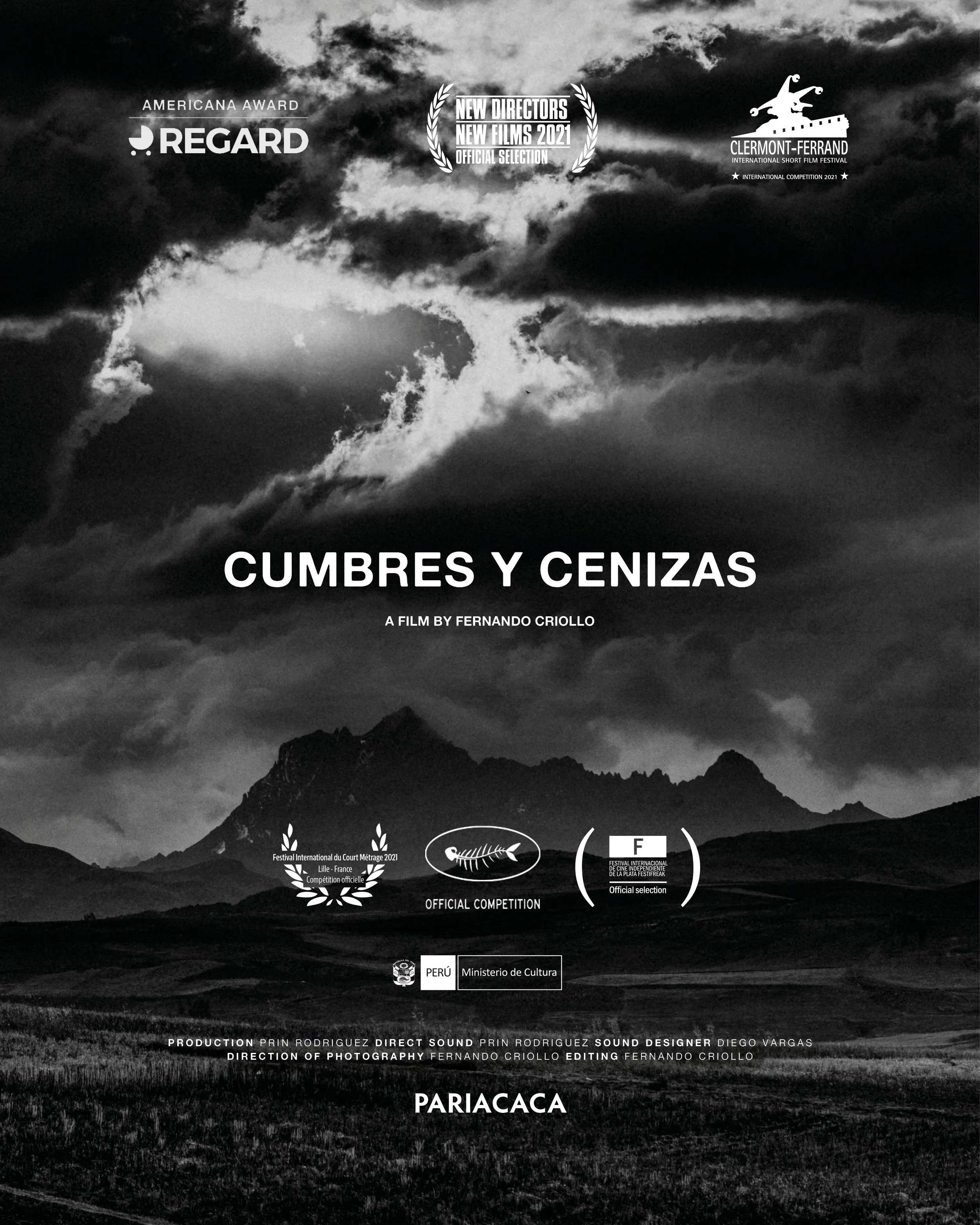
CUMBRES Y CENIZAS
Caminamos rumbo hacia lo más alto que nos permiten las piernas y el pensamiento. Aquí, donde el oxígeno se diluye a cada paso, nuestros alientos se entreveran con la música y se pierden entre las explosiones, gritos y montañas infinitas. El viento carga con todo el peso vivo sobre sus hombros y canta en el idioma de las elegidas y los elegidos. Allí nos esperan los vestigios del choque entre dos mundos. ¿Nos volveremos a encontrar?
We walk towards the highest that our legs and our thoughts allow. Here, where the oxygen is diluted with each step, our breaths intermingle with the music and are lost among the explosions, screams and infinite mountains. The wind carries all the living weight on its shoulders and sings in the language of the chosen ones. There, the vestiges of the clash between two worlds await us. Will we meet again?
2021 - 50th MoMA's New Directors/ New Films Festival
2021 - Clermont Ferrand International Short Film
2021 - REGARD – Saguenay International Short Film Festival - WINNER AMERICANA
2021 - Linea d'Ombra Festival - WINNER OPEN JURY
2021 - Lille International Short Film Festival
2021 - Psarokokalo International Short Film Festival
2021 - Tabor Film Festival
2021 - Festival Internacional de Cine Independiente de La Plata Festifreak
2021 - Festival Internacional de Curtas do Rio de Janeiro
Duration 17:26 min
Status Released
Directed by Fernando Criollo
Produced by Prin Rodriguez
Sound Design Diego Vargas
Cinematography Fernando Criollo
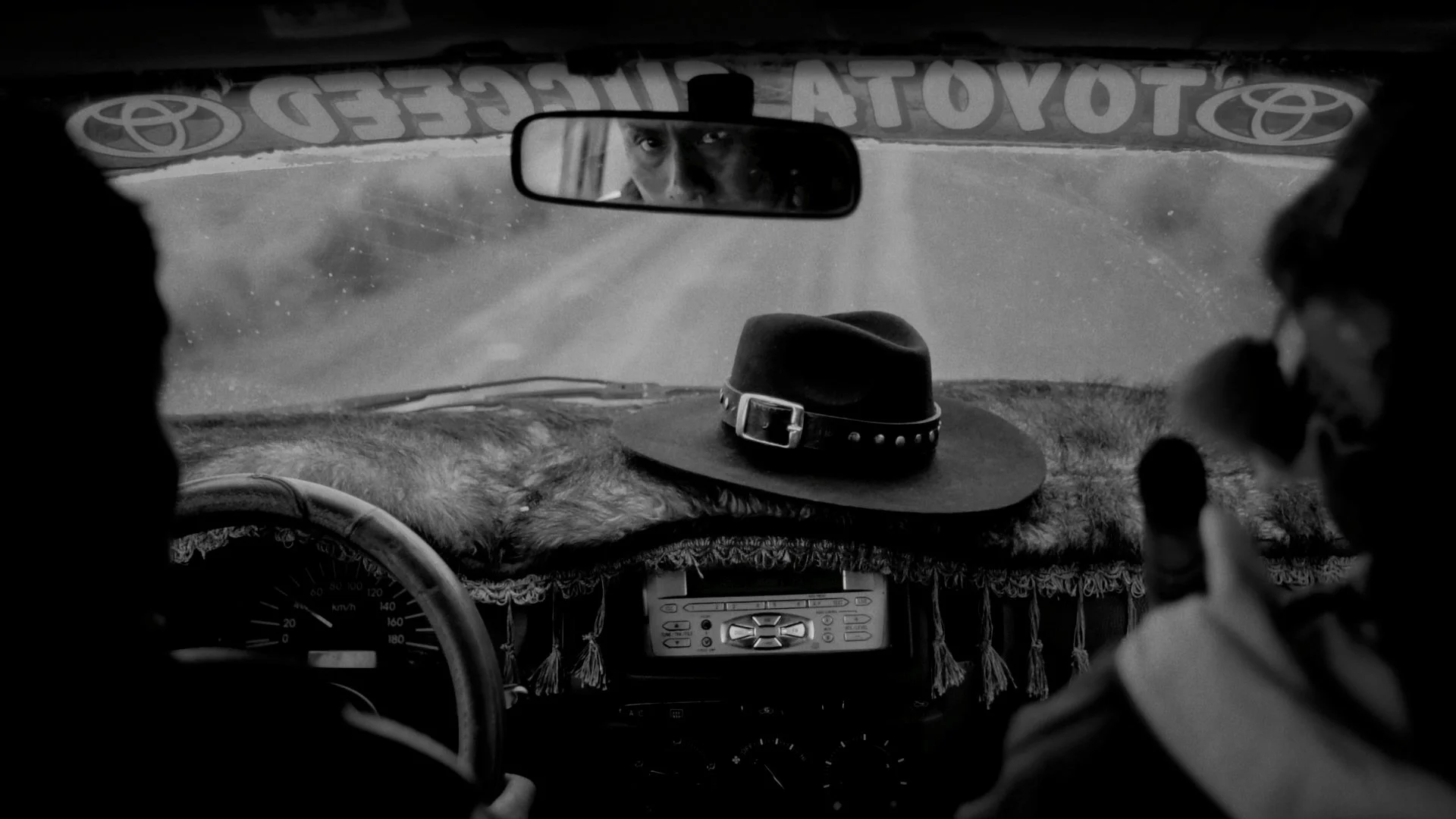
Cumbres y Cenizas de Fernando Criollo es un documental etnográfico filmado en gran parte en blanco y negro en las montañas peruanas. Comienza de manera memorable, con una toma de humo que se eleva y pájaros volando en el horizonte. A medida que se escuchan explosiones atronadoras, pronto queda claro que Criollo rara vez busca que el sonido coincida por completo con sus imágenes, una decisión que amplifica enormemente las atmósferas emocionales y espirituales de las ceremonias en pantalla. Al inicio de la película, Criollo utiliza una ambientación metálica, grabaciones de bronces y platillos festivos, y las mencionadas explosiones para acompañar una toma en cámara lenta.
Vemos a decenas de hombres alineados en filas cargando una estatua, y cuando todo el sonido se disipa, el silencio potencia la grandiosidad de la imagen. La razón de Criollo para prescindir del color es evidente: las imágenes en escala de grises hacen que todo parezca interconectado, fundiéndose entre sí: las personas y la tierra, las montañas y el cielo, la luz y la oscuridad.
Cuando vemos pequeños fragmentos de granizo blanco caer sobre un terreno oscuro, se siente idéntico a observar a un grupo de personas cantar y agitar banderas en una calle: todos somos apenas pequeños seres dentro del gran esquema de las cosas. Mientras tanto, el montaje aturdido de la música es una invitación a apreciar estas imágenes y sonidos como algo más allá de meros elementos texturales; se nos pide que nos desplacemos, que dejemos el ego a un lado.
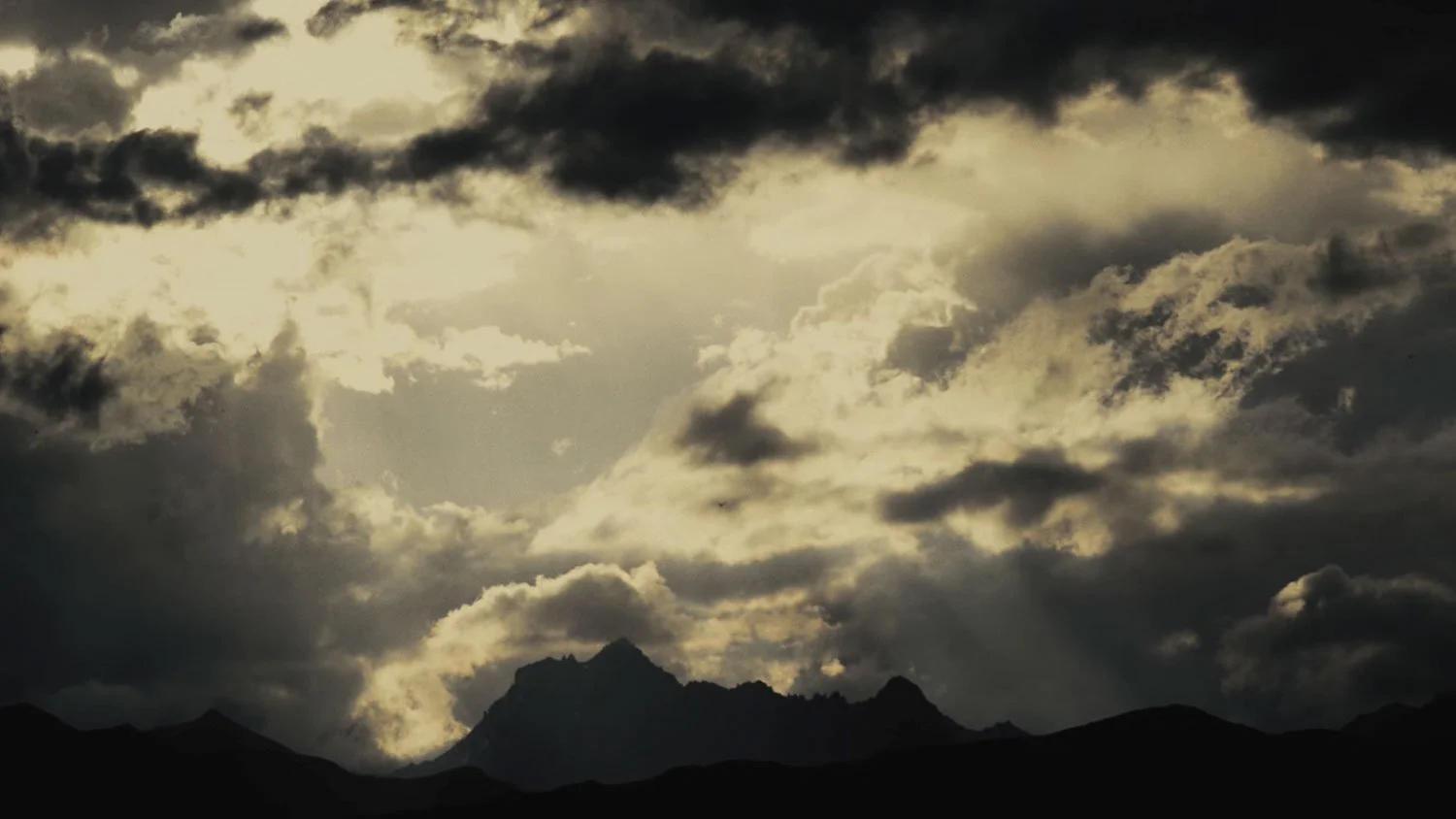
Y aunque el propósito de estas ceremonias nunca se explica, hay una comprensión de la unidad, la comunidad y la existencia de algo más allá de nuestros limitados selves. Cuando una voz envuelta en reverberación declara palabras al "Padre Santo", Criollo cierra con una hermosa imagen de montañas y nubes teñidas de un amarillo dorado. Es una recalibración: una representación visual y sonora del antes y el después de la ceremonia. En el resultado, todo es sacrosanto.
- Joshua Minsoo Kim / In Review Online
Fernando Criollo’s Summits and Ashes is a largely black-and-white ethnographic documentary shot in the Peruvian mountains. It begins memorably, with a shot of billowing smoke and birds flying overhead. As thunderous explosions are heard, it’s soon obvious that Criollo is rarely aiming to have the sound completely match his images — a decision that greatly amplifies the emotional and spiritual atmospheres of the ceremonies onscreen. Early on in the film, Criollo utilizes metallic ambience, recordings of celebratory brass and cymbals, and the aforementioned explosions to score a slow-motion shot.
We see dozens of men aligned in rows while carrying a statue, and as all sound dissipates, the silence bolsters the grandiosity of the image. Criollo’s rationale for forgoing color is obvious: the grayscale images make everything feel interconnected, bleeding into each other — the people and the land, the mountains and the sky, the light and the dark.
When we see pieces of white hail falling onto a dark patch of land, it feels no different than watching a group of people sing and wave flags on a street: we’re all but small beings in the grand scheme of things. Meanwhile, the woozy editing of music here is an invitation to appreciate these images and sound as something beyond mere textural elements; we’re asked to displace ourselves, to check our ego.
And even though the intent of these ceremonies isn’t ever explained, there’s an understanding of togetherness and community and the existence of something beyond our limited selves. When a reverb-drenched voice declares statements to the “Holy Father,” Criollo ends with a beautiful image of mountains and clouds, tinted with a golden yellow. It’s a recalibration; a visual and aural depiction of pre- and post-ceremony. In the aftermath, everything is sacrosanct.
- Joshua Minsoo Kim / In Review Online
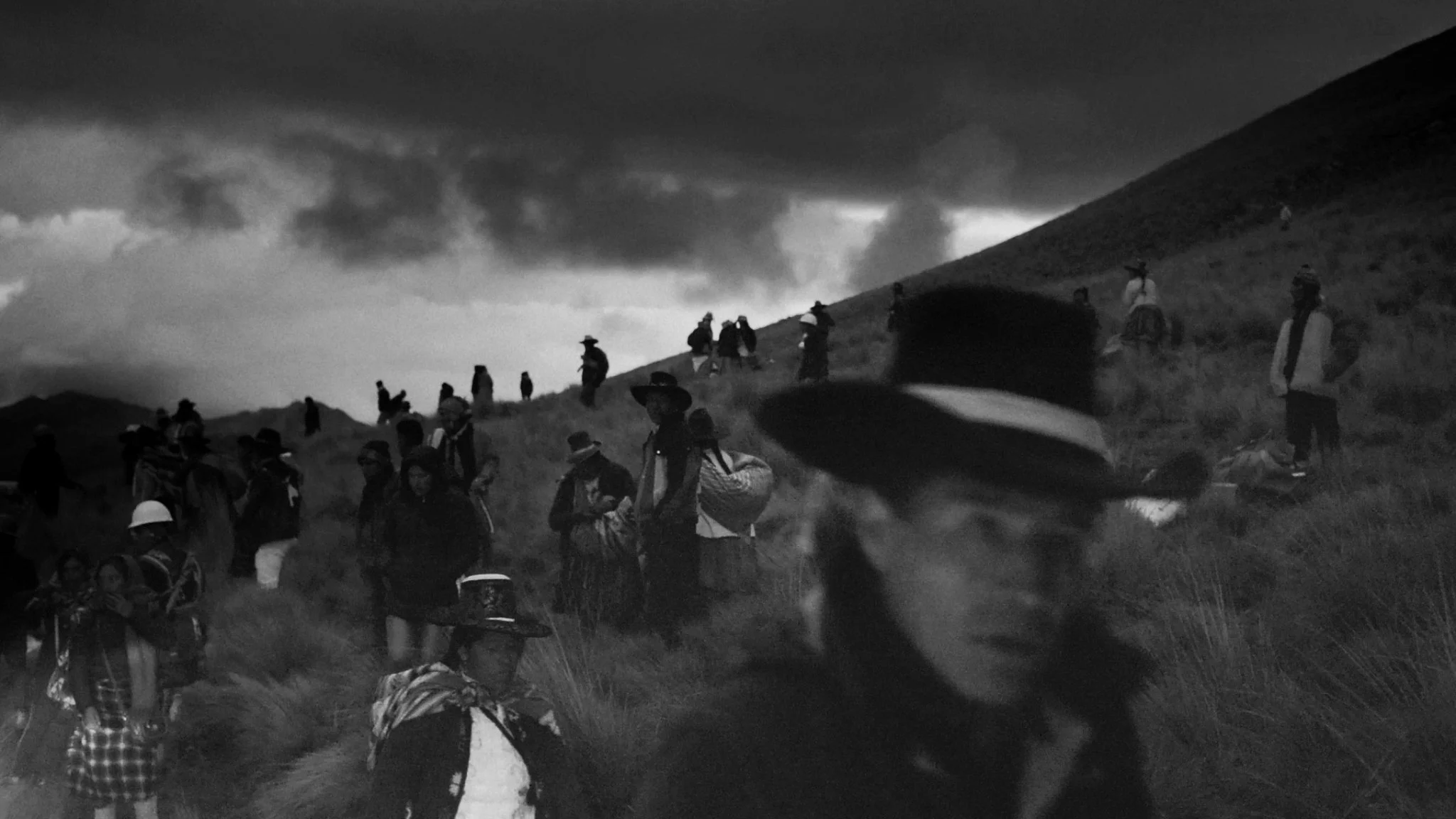
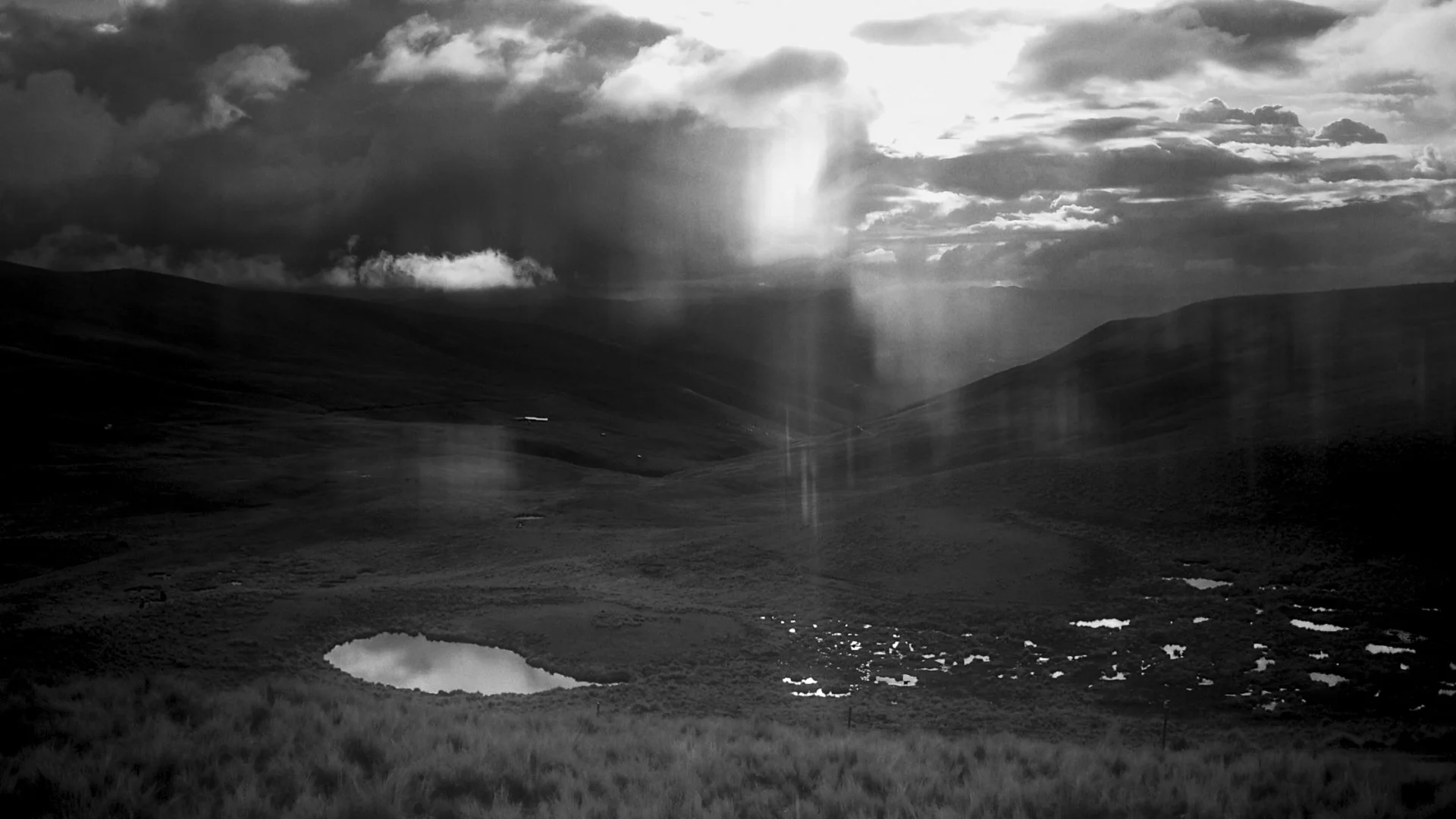
Una de las más notables películas de la sección es Cumbres y cenizas del peruano Fernando Criollo. También es, en parte, un documental de observación sin ningún tipo de narración que nos introduzca o explique lo que estamos presenciando. Vemos la montaña y un grupo de gente heterogénea reunida en ella. Como en Destello bravío, un grupo marcha en procesión cargando sobre los hombros, no sin dificultad, una figura religiosa (¿San Sebastián?). Otro grupo de muchachos, identificados con unas chaquetas que dicen “escorpiones”, canta con entusiasmo en quechua. Criollo no solo presta atención a los actores humanos de esa especie de ritual no explicado diegéticamente, sino también al ambiente no humano: la montaña, las nubes, el granizo; una conjunción de elementos físicos variables de innegable espectacularidad apropiadamente captados por la fotografía mayormente en blanco y negro del director.
Hay aquí un tendido ritual de lazos entre la tierra y el cielo. Viendo la película recordé un haiku de Natsume Soseki:
Cielos y tierra
en uno se han fundido:
niebla primera
Pero si en el poeta es la niebla la que, como un velo, desciende de las nubes hasta el suelo o se eleva del suelo hasta las nubes, según se mire, para comunicar y generar continuidad entre esos dos reinos opuestos, en Cumbres y cenizas no es la niebla sino una mezcla entre una ritualidad difusa (no difusa en sí misma sino en la forma antiexplicativa en que Criollo decide mostrarla) y una construcción de los planos y del montaje que va de esa humanidad indígena reunida en el sincretismo cristianismo (Cielo)-pachamamismo (Tierra) a los propios cielo y tierra ya no ideales sino materiales: un crescendo de montañas con nubarrones oscuros y claros (otro juego de dobles opuestos pero complementarios y continuos típico de las culturas andinas en particular y del barroquismo americano en general: oscuridad y luz), la luna y las estrellas en el firmamento nocturno, columnas de humo que suben desde la montaña a los cielos (vestigios de la actividad humana de conexión con las alturas divinas), artefactos antiguos, arqueológicos, con destellos de luces artificiales (verdes y rojos). Finalmente, la ciudad de noche y, luego de un corte, un cielo nuboso y amarillento, como de un amanecer o de un atardecer. Además, antes que de la fusión de la que habla Soseki hay aquí conexión, comunicación alto-bajo.
Respecto de los rituales y su no explicación o contextualización, Criollo ha dicho que no son el asunto del film en sí mismo, que no ha querido ni describir ni hablar de las celebraciones. “Deseo que la imagen y el sonido nos permitan presenciar el ritual ante la invocación de nuestros ancestros, aquellos que caminaron a través de los mismos lugares frente a nosotros. Lo interesante de esto es que, como en todos los rituales, especialmente los rituales de sangre, solo es presenciado en su totalidad por la persona que realiza el sacrificio, profanándose a sí mismo, y volviéndose un enigma que no puede ser visto por todos”.
La capacidad plástica como fotógrafo le permite a Criollo, quizás, si no evitar por completo, al menos tangenciar la descontextualización por medio de la expresión de los signos cosmovisuales involucrados y encarnados en el propio ecosistema: la montaña y las nubes, la oscuridad y la luz, la tierra y el cielo, la Pachamama y Cristo. Esto es un triunfo.
One of the most remarkable films in the section is Cumbres y cenizas (Summits and Ashes) by the Peruvian filmmaker Fernando Criollo. It is also, in part, an observational documentary without any narration to introduce or explain what we are witnessing. We see the mountain and a heterogeneous group of people gathered upon it. As in Destello bravío, a group marches in procession, carrying with some difficulty a religious figure (San Sebastián, perhaps?) on their shoulders. Another group of young men, wearing jackets that read “Scorpions,” sings enthusiastically in Quechua. Criollo not only focuses on the human actors of this sort of ritual—left unexplained diegetically—but also on the non-human environment: the mountain, the clouds, the hail; a conjunction of shifting physical elements of undeniable spectacle, appropriately captured in the director’s mostly black-and-white cinematography.
Here there is a ritual weaving of ties between earth and sky. Watching the film, I recalled a haiku by Natsume Soseki:
Heaven and earth
have merged into one:
first mist
But whereas in the poet’s verse it is the mist that, like a veil, descends from the clouds to the ground—or rises from the ground to the clouds, depending on the perspective—in order to connect and generate continuity between those two opposing realms, in Summits and Ashes it is not mist but rather a blend of diffuse rituality (not diffuse in itself, but in the anti-explanatory manner in which Criollo chooses to show it) and a construction of shots and editing that moves from that Indigenous humanity gathered in the syncretism of Christianity (Heaven) and Pachamama worship (Earth), to the actual sky and earth, no longer ideal but material: a crescendo of mountains under dark and light storm clouds (another play of opposite yet continuous and complementary dualities, typical of Andean cultures in particular and American baroque in general: darkness and light), the moon and stars in the night sky, columns of smoke rising from the mountain into the heavens (remnants of human activity reaching toward the divine heights), ancient archaeological artifacts with flashes of artificial light (green and red). Finally, the city at night and, after a cut, a cloudy yellowish sky, like a sunrise or sunset. More than the fusion Soseki speaks of, there is here a connection, an upward-downward communication.
Regarding the rituals and their lack of explanation or contextualization, Criollo has said that they are not the subject of the film itself, that he did not wish to describe or speak of the celebrations. “I want the image and sound to allow us to witness the ritual in the invocation of our ancestors, those who walked through the same places before us. What is interesting is that, as in all rituals, especially rituals of blood, it is only fully witnessed by the person who performs the sacrifice, desecrating himself, becoming an enigma that cannot be seen by everyone.”
His plastic capacity as a photographer allows Criollo, if not to entirely avoid, then at least to brush against decontextualization through the expression of the cosmovisual signs involved and embodied in the ecosystem itself: the mountain and the clouds, darkness and light, earth and sky, Pachamama and Christ. This is a triumph.
- Ezequiel Iván Duarte / TAIPEI Magazine